ONE-BLUE project organized last Thursday, June 6 the webinar ‘ONE-BLUE: Synergies for the Protection of Oceans and Marine Environment’, which served as a platform to present the main activities of the European project ONE-BLUE, funded by the Horizon Europe programme of the European Union. The webinar was held within the framework of the European Green Week 2024, which has the theme ‘Towards a Water Resilient Europe’. The day was a meeting point for stakeholders from the sector, including project partners, environmental agencies, researchers, scientists and other European projects.
The event, hosted by Jon Larrachea, European project communication assistant at the Finnova Foundation, started with a welcome address by Alessandra Giorgetti, deputy head of the Oceanography Section at the Italian National Institute of Oceanography and Experimental Geophysics and coordinator of EMODnet Chemistry. During her intervention, Giorgetti gave an overview of EMODnet, the European Marine Observation and Data Network, chemical data standards and practices for data management and validation.
The project leaders and researchers at CSIC-IDAEA, Marinella Farré and Marta Llorca, stressed the importance of addressing the care, management and protection of water at a time when climate change, pollution and the degradation of ecosystems require urgent solutions to preserve this fundamental resource.
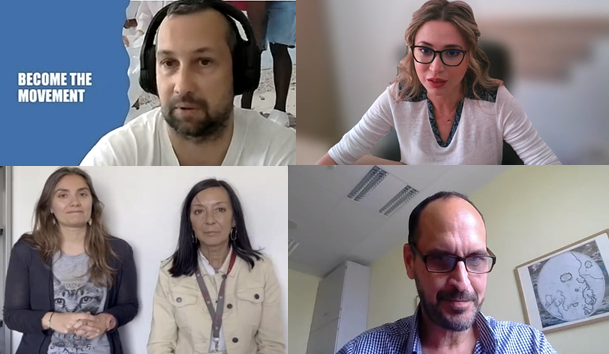
During the first panel of the webinar, several lines of research to be developed in the Arctic Ocean, the Mediterranean Sea and the Arctic Ocean were presented and served to introduce ONE-BLUE. Boris Koch, professor at the Bremerhaven University of Applied Sciences and representative of the Alfred Wegener Institute, presented the research and chemical ecology activities in the Arctic Ocean. Montsé Sala, head of the Marine Biology and Oceanography department at ICM-CSIC, shared details of her research in marine biology and oceanography in the Mediterranean Sea, detailing the activities that ONE-BLUE will carry out in the Iberian Peninsula. From Dublin City University, Anne Morrisey, Associate Professor in the School of Mechanical Engineering and Manufacturing, detailed her research in mechanical engineering and manufacturing in the Atlantic Ocean, focusing on the samples to be collected in the Irish Sea.
The second panel of the webinar focused on a presentation of projects aligned with the European mission ‘Restore Our Oceans and Waters’, an initiative of the European Commission that aims to protect and restore the health of the ocean and waters through research, citizen participation and blue investments. Steven Degraer, coordinator of the BLUE4ALL project highlighted the key aspects of the project related to marine ecology and coastal management, highlighting the use of living labs, to create effective, efficient and resilient networks that contribute to the protection of marine protected networks. PROTECT BALTIC, represented by Aino Ahvo, GIS data analyst at the Helsinki Commission, highlighted the main objectives and results of the project focusing on the management and protection of the Baltic Sea. Finally, the REMEDIES project was also presented, whose coordinator, Uroš Novak, emphasized the project’s achievements in marine pollution detection and management and the PLASTIC FANTASTIC hackathon, which promotes innovative solutions to reshape the life cycle of plastic.
The third and last panel, which also hosted initiatives framed within the European mission ‘Restore Our Ocean and Waters’, focused on the importance of creating synergies between European projects. In this sense, the NETTAG+ Project, a project scaled up thanks to the synergies created in the original NETTAG project, participated through Lisa Sousa, Science and Technology Manager at CIIMAR, who presented the methodology and results of a project focused on the monitoring and sustainable management of fisheries. Finally, Raluca Nicolae, technical director of the Environment Department at GEOSTUD, addressed the approaches and strategies of the DaWetRest project for wetland restoration and water resources management.