- A new scientific study published in Emerging Contaminants identifies eight types of plastic polymers and more than 100 plastic-associated chemicals, highlighting the importance of looking beyond visible microplastic particles to understand marine pollution.
Barcelona, 11 November 2026. – Researchers involved in the European Horizon Europe project ONE-BLUE have published a new scientific study in the journal Emerging Contaminants, examining the presence and distribution of plastic polymers and associated chemical substances along the Irish Sea coast.
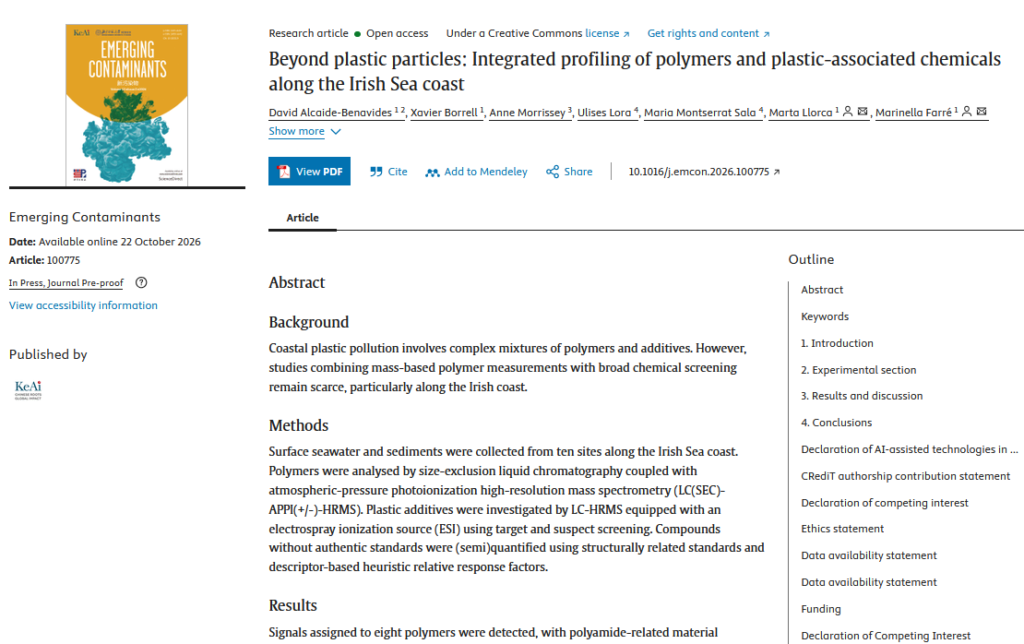
The study, entitled “Beyond plastic particles: Integrated profiling of polymers and plastic-associated chemicals along the Irish Sea coast”, was carried out by David Alcaide-Benavides, together with researchers from the Institute of Environmental Assessment and Water Research (IDAEA-CSIC), Dublin City University and the Institute of Marine Sciences (ICM-CSIC).
While plastic pollution is often associated with visible waste and microplastic particles, plastics also contain a wide range of chemical additives used during manufacturing. These substances can be released into the environment, making them an important aspect of marine pollution that is not always considered in conventional monitoring.
What did the researchers find?
The research analysed seawater and sediment samples collected from ten coastal locations along the Irish Sea, combining the identification of plastic polymers with the detection of chemical substances associated with plastic materials.
The results revealed eight types of plastic polymers, with polyamide and polyethylene being the most frequently detected. These materials are widely used in everyday products, including synthetic textiles, packaging and fishing equipment.
The team also identified 108 plastic-associated chemicals in seawater and 62 in sediments, including plasticizers, stabilizers and other compounds used in industrial and consumer products.
Interestingly, the study revealed differences in how these substances are distributed across marine environments. Seawater contained a wider variety of chemicals, suggesting continuous inputs and transport through marine currents, while sediments showed more selective accumulation of certain compounds.
Understanding marine pollution beyond plastic particles
By studying both polymers and associated chemicals, the research provides a more comprehensive picture of plastic pollution in coastal environments.
The findings highlight the importance of expanding marine pollution monitoring beyond counting microplastic particles, as chemical substances associated with plastics may follow different pathways and accumulate in different parts of the marine environment.
Although some detected chemicals may also originate from sources unrelated to plastics, the study helps identify contamination patterns and substances that deserve further investigation.
Supported by ONE-BLUE, this research contributes to the project’s efforts to improve knowledge of emerging marine contaminants and advance scientific approaches for monitoring and protecting marine ecosystems.
Read the full scientific article:
Beyond plastic particles: Integrated profiling of polymers and plastic-associated chemicals along the Irish Sea coast
Emerging Contaminants (2026)