At an event at the European Committee of the Regions, the project underlined that scientific evidence, prevention at source and stronger territorial cooperation are essential to protect water resources, biodiversity and human health.
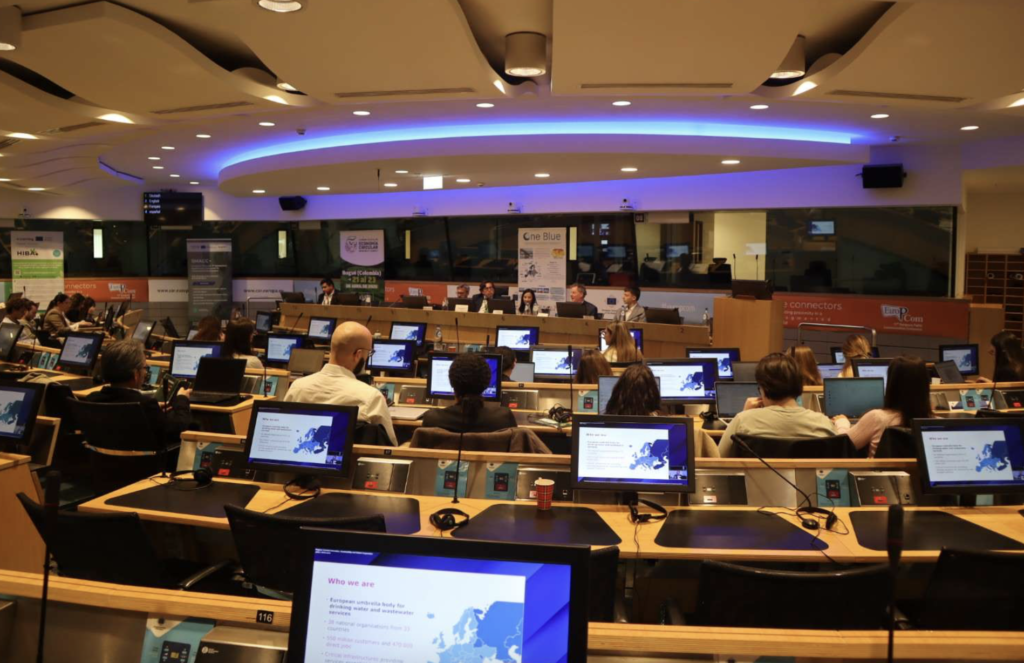
On 11 June 2026, the European project ONE-BLUE held the event “ONE-BLUE: Addressing emerging contaminants from regional and local governance perspective” at the European Committee of the Regions in Brussels, in a hybrid format. The event brought together EU representatives, scientists, water-sector organisations and blue economy experts on how Europe can better respond to emerging contaminants in aquatic ecosystems.
The debate showed that emerging contaminants are not only a scientific or technical challenge, but also a governance issue. The discussion placed particular emphasis on the need to adapt European policies to different territorial realities, strengthen water resilience in the context of climate change and improve coordination between EU institutions, regions, municipalities, researchers and water operators.
In his intervention, Nils Torvalds, Rapporteur of the revised Urban Wastewater Treatment Directive and former Member of the European Parliament, stressed that water resources are not equally distributed across Europe and that new EU legislation will bring important challenges for water management, particularly in relation to agriculture, infrastructure and PFAS. This territorial perspective was reinforced by Joachim D’Eugenio, Policy Adviser, ENV.C: Zero Pollution, Water Resilience & Green Urban Transition at the European Commission, who underlined the need to maintain clear water quality objectives while strengthening water resilience and adapting policies to the specific needs of regions and cities.
From the scientific perspective, Marinella Farré, Coordinator of ONE-BLUE and researcher at IDAEA-CSIC, explained that thousands of contaminants of emerging concern are present in aquatic environments, making it difficult to assess their combined impacts and regulate them individually. She highlighted ONE-BLUE’s role in generating scientific evidence on the distribution and effects of these substances in European seas. In the same line, Ethel Eljarrat, Director of IDAEA-CSIC, stressed that science is advancing faster than regulation and that identifying and prioritising the most hazardous substances is essential to improve risk assessment for ecosystems and human health.
The contribution of water operators brought the debate closer to implementation. Oliver Loebel, Secretary General of EurEau, the European federation representing national associations of drinking water and wastewater services, warned that conventional treatment systems are often not sufficient to remove persistent pollutants such as PFAS and pharmaceutical residues. Hugo Harvey, Policy Officer at Aqua Publica Europea, the European association of public water operators promoting public management, affordability and the general interest in water services, argued that prevention at source is cheaper and more effective than trying to remove contaminants once they have entered the water cycle.
Applied research and digitalisation were also identified as key elements for future decision-making. Piet Seuntjens, Research Leader Water at VITO, a Flemish research organisation working on cleantech and applied environmental solutions, highlighted the importance of advanced analytical tools, including target analysis for known substances and non-target analysis to detect unknown or unexpected contaminants. Fernando Rojas, Director of the Blue Economy Chair at Miguel Hernández University, reflected on the need for governance systems to become more dynamic, especially as marine environments can increasingly be monitored almost in real time.
The event closed with remarks by Juan Manuel Revuelta, CEO of Finnova, who underlined the importance of connecting European research with funding opportunities, innovation and implementation at regional and local level.