- This study has demonstrated the viability of using high-frequency ultrasound to quantify the concentration of microplastics in liquids
- Forum Acusticum Euronoise 2025 gathered renowned experts, researchers and professionals in the field of acoustics, providing a platform for the exchange of cutting-edge knowledge and collaborative discussions
On Wednesday, June 25, the Institute of Physical and Information Technologies (ITEFI) of the Spanish National Research Council (CSIC) presented a study at the 11th Convention of the European Acoustics Association (Forum Acusticum Euronoise 2025). The study, presented by Óscar Martínez, tenured scientist at ITEFI, was developed within the framework of the ONE-BLUE project and demonstrates the feasibility of using high-frequency ultrasound to quantify microplastic concentrations in liquids.
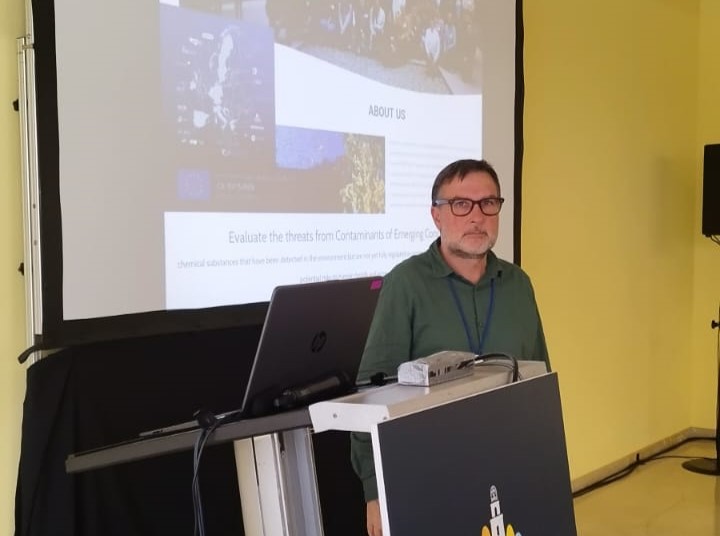
The accumulation of microplastics in oceans poses an increasing threat to marine ecosystems, human health, and the global economy. To address this challenge, the ITEFI team has developed a non-invasive technique based on high-frequency ultrasound (20–50 MHz), capable of detecting suspended particles without the need for chemical markers or sample preparation.
The experimental system, optimized for potential integration into onboard instruments, uses a 1 mm-diameter flow channel through which contaminated samples pass. The energy reflected by the particles is processed with image analysis algorithms to estimate their concentration. The method has been calibrated with monodisperse polystyrene particles and has proven reliable and reproducible even under variable flow conditions.
This study confirms the feasibility of using high-frequency ultrasound to quantify microplastic concentrations in liquids. The measurement protocol, though flow-dependent, is reliable and reproducible, with uncertainty margins defined. Current efforts focus on optimising flow velocity to improve resolution and extend detection to lower concentrations. Alternative signal descriptors, like energy density, are being explored to refine concentration estimates and address challenges at high flow rates. While validation with polydisperse samples is still limited and the influence of natural microorganisms remains unexamined, these findings lay the groundwork for a next-generation, low-power prototype suitable for integration into compact platforms.