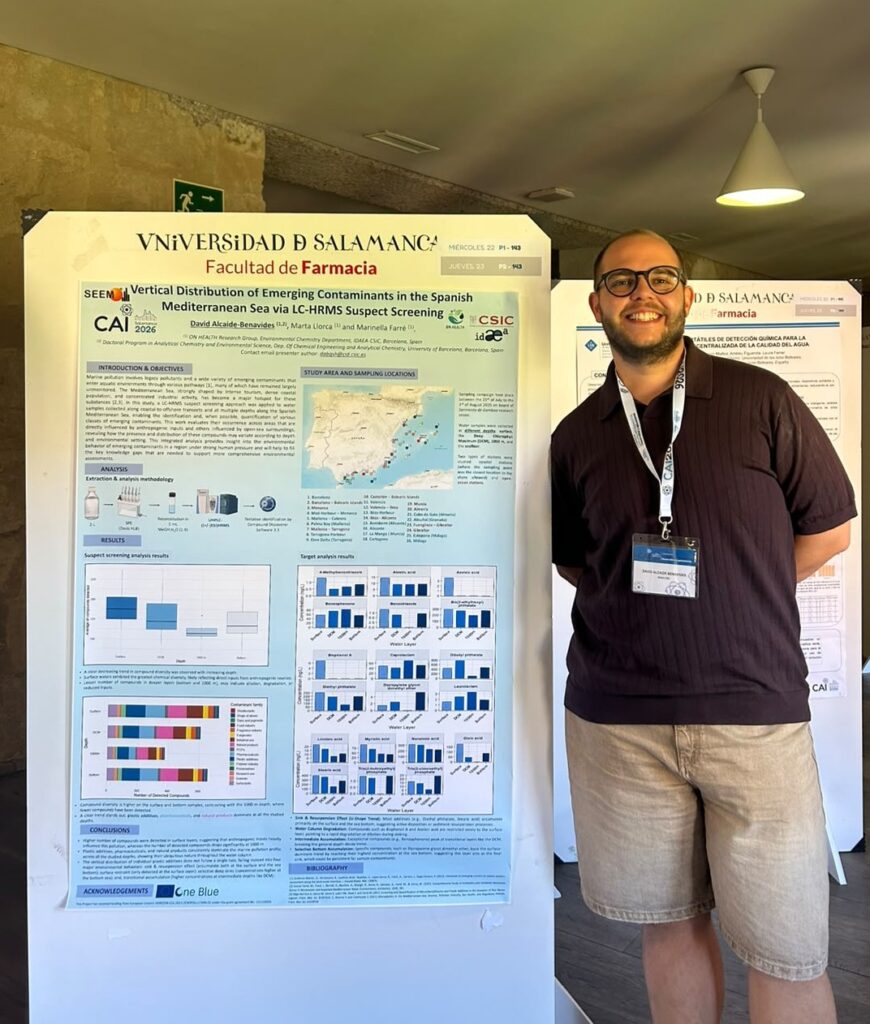
ONE-BLUE was presented on 22 July at the CAI2026, in Salamanca, Spain. David Alcaide, a PhD researcher within ONE-BLUE, presented the poster “Vertical Distribution of Emerging Contaminants in the Spanish Mediterranean Sea via LC-HRMS Suspect Screening”, co-authored by Prof. Marinella Farré and Dr. Marta Llorca.
The study presented new findings on the presence and distribution of contaminants of emerging concern (CECs) in the Spanish Mediterranean Sea, highlighting how human-made chemicals are distributed throughout the water column, from surface waters to the seafloor. Using advanced analytical techniques capable of detecting substances that are not routinely monitored, the researchers investigated the vertical distribution of a wide range of contaminants.
The Mediterranean Sea is one of the world’s most intensively used marine regions. High levels of tourism, dense coastal populations, and industrial activities contribute to the release of numerous contaminants into marine ecosystems. Many of these substances, known as CECs, include plastic additives, pharmaceuticals, and personal care product ingredients that may pose risks to the environment but remain insufficiently studied.
The study found that surface waters contained the highest diversity of contaminants, reflecting the direct influence of human activities on the marine environment. The researchers also observed that plastic additives followed different distribution trends depending on depth: some accumulated at the surface and seafloor, others were restricted to surface waters, while certain compounds showed peaks at intermediate depths or near the seabed. These findings indicate that CECs do not behave uniformly once they enter the marine environment. The researchers concluded that anthropogenic pollution strongly affects surface waters throughout the Spanish Mediterranean Sea, while contaminant diversity decreases considerably at greater depths.
This work provides valuable new insights into how emerging contaminants are transported and persist in marine ecosystems. The findings will help scientists and policymakers improve environmental assessments and develop more effective strategies to protect Mediterranean marine environments.