- INL showcased the new technology for the online monitoring of antibiotics in the ocean that is being developed in ONE-BLUE
- These updates were shown to more than 150 attendees
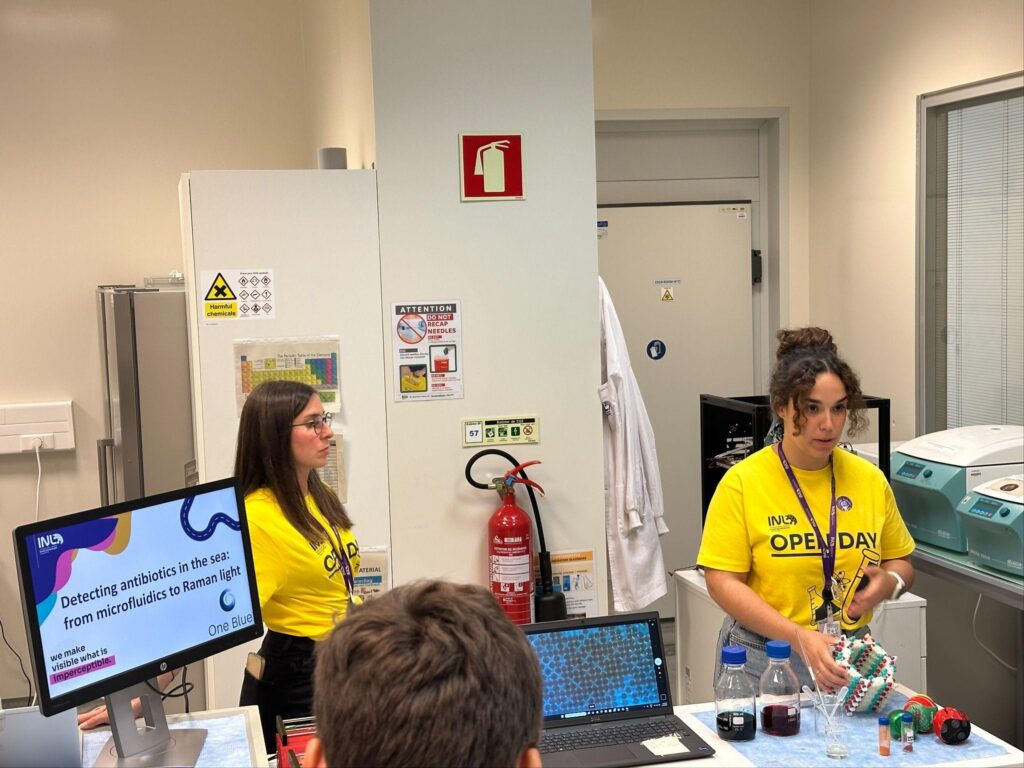
The International Iberian Nanotechnology Laboratory (INL), partner of the ONE-BLUE project, presented the latest developments in antimicrobial detection during the INL Open Day 2025, held in Braga, Portugal. The innovations were featured as part of the “Biolabs Special Tours,” a series of guided visits that allowed over 150 participants to explore INL’s cutting-edge laboratories.
ONE-BLUE was highlighted in a tour specifically focused on antimicrobial resistance (AMR), offering attendees a hands-on look at how antibiotics can be detected in aquatic environments. INL researchers demonstrated the project’s progress in developing real-time monitoring tools, including an online detection system based on surface-enhanced Raman scattering (SERS). This system features a miniaturized Raman spectrometer integrated into a buoy, enabling remote monitoring of antibiotic residues in ocean water. The technology combines a covalent organic framework that concentrates antibiotic molecules near gold nanoparticle-based sensors, with microdroplet microfluidics to enhance sensitivity and detection accuracy. In addition to the technical demonstration, visitors also learned about complementary approaches used to detect and identify antibiotic-resistant microorganisms, including laboratory cell culture techniques and molecular biology tools for tracking AMR pathogens.
Throughout the day, five different tours raised awareness about the spread of antimicrobial resistance between humans, animals, and the environment—an issue central to ONE-BLUE’s mission. As the use of antibiotics grows, so does the risk: residues often enter wastewater systems, where traditional treatment processes are not equipped to eliminate them. These compounds can then reach rivers, lakes, and oceans, contributing to the environmental spread of resistant microbes.
In response, ONE-BLUE is working to deepen scientific understanding and develop effective mitigation strategies. By conducting case studies in the Atlantic, Arctic, and Mediterranean regions, the project aims to assess the presence and impact of contaminants of emerging concern (CECs)—with a special focus on antibiotics in marine ecosystems.