- The project was presented by IDAEA-CSIC, the leader of the project.
- The Society of Environmental Toxicology and Chemistry (SETAC) provides a key platform for advancing scientific collaboration in environmental science and management
ONE-BLUE attended the SETAC Europe 35th Annual Meeting, held inVienna (Austria) from Sunday, 11th to Thursday, 15th May, through our leader entity the Institute of Environmental Assessment and Water Research (IDAEA-CSIC). Our representatives attended this meeting being part of a session on marine ecotoxicology and presented two case studies aimed at mitigating the impact of marine pollution.

Marinella Farré, project coordinator, was part of the chair for the “Marine Ecotoxicology: Anthropogenic Pressures on Marine Organisms and Habitats, Current Challenges and Solutions” session. The session delved into the latest research on the effects of anthropogenic pressures on marine organisms and their habitats while highlighting innovative mitigation strategies. Presenters discussed how stressors at various scales, from genes to entire ecosystems, affect marine life.
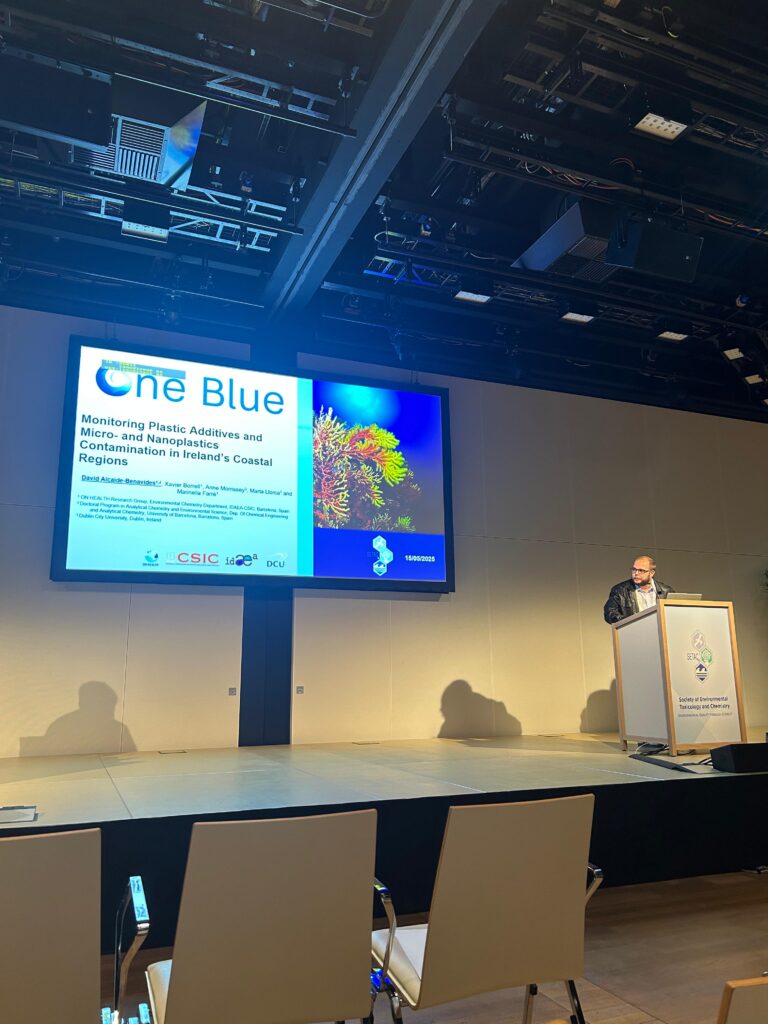
David Alcaide Benavides, PhD student at IDAEA-CSIC, presented the “Monitoring Plastic Additives and Micro and Nanoplastics in Ireland’s Coastal Regions” case study in this session, focused on the rising plastic pollution along the Irish coast registered during ONE-BLUE’s sampling campaign last June. During the session, Alcaide presented the research findings, which showed elevated concentrations of both microplastics and additives in the northern sites and the Dublin area. These densely populated and industrialised areas are likely polluted due to urban wastewater, industrial discharge, and maritime activities, whereas the southern sites exhibited lower levels. The study also highlights the importance of monitoring both water and sediment to assess the extent of plastic contamination fully. These findings highlight clear spatial trends in pollution and underscore the importance of monitoring both water and sediment to understand the extent of plastic contamination.
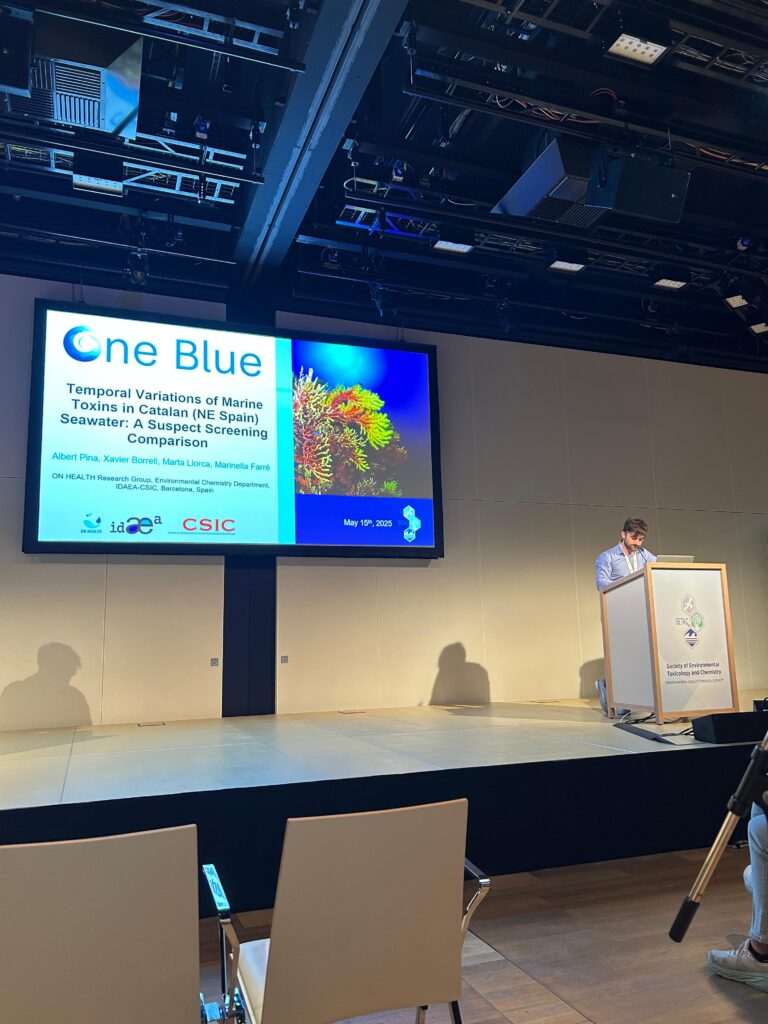
On the other hand, Albert Pina i Benages, PhD student at IDAEA-CSIC, presented the case study titled “Temporal Variations of Marine Toxins in Catalan Seawater: A Suspect Screening Comparison”. The study examined the variation of marine biotoxin levels in surface seawater along the Catalan coast, comparing results from samples taken along 2024 and with a retrospective evaluation of samples previously studied by our group a decade ago to assess potential shifts in toxin diversity and concentrations. The results from his research proved a significant increase in Okadaic acid (OA) in the Catalan coast when compared to data gathered in 2015, which may be attributed to the intense rainfall in October 2024 compared to 2015, leading to a greater influx of contaminants from rivers into the sea. Furthermore, toxin concentrations were consistently higher in eutrophic areas, such as the Ebro Delta, than in open-sea regions.
Events such as the SETAC Europe 35th Annual Meeting offer an invaluable platform for bringing together professionals, students and policymakers from around the world. SETAC Europe Annual Meetings promote not only the dissemination of cutting-edge research but also critical dialogue on policy relevance, technological innovation, and collaborative solutions. This year, over 2600 international professionals and students gathered in Vienna to promote the discussion of enhancing environmental quality through science.