- This sampling campaign was postponed due to adverse weather conditions on the Italian coast.
- This research concludes the third campaign of the project, after the campaigns in the Irish Sea and the Arctic Ocean
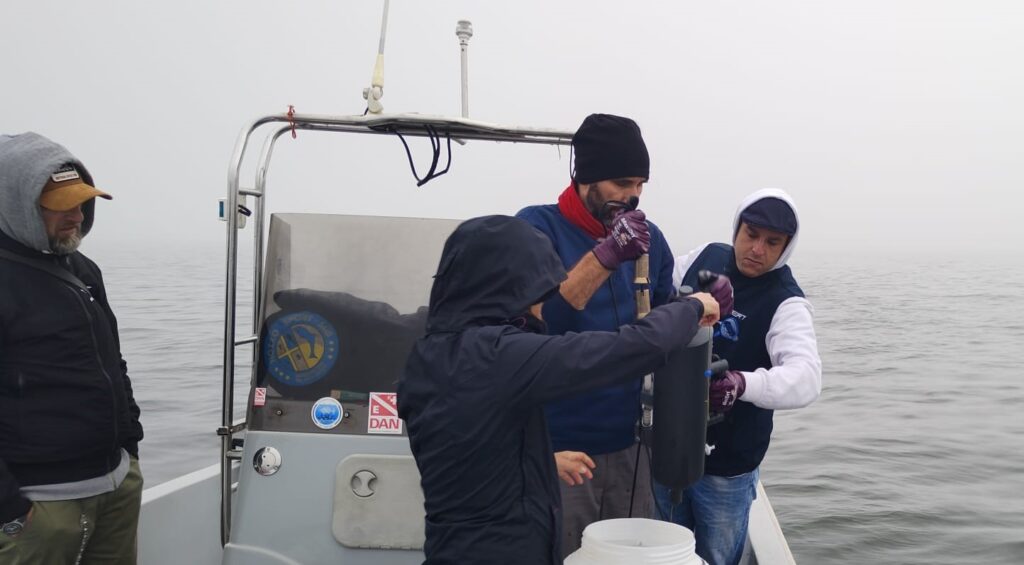
ONE-BLUE has completed the first part of its sampling campaign in the northern Adriatic Sea. During the last two weeks, our partners the University of Padova (UNIPD) and Italian National Research Council (CNR-IRSA) have completed the sampling campaign along the Veneto coast (Italy) collecting samples from the four stations that could not be explored during the first expedition due to adverse weather conditions.
Last Thursday, October 24 UNIPD took water and sediment samples from two stations and CNR-IRSA extracted and filtered the samples. Last week the expedition finalized the sampling campaign after exploring the last two stations, completing the six sampling stations to be covered in this area. This second part of the campaign has focused on collecting fish and shellfish samples, and the biota will be dissected for subsequent chemical analyses.
North Adriatic Campaign in a nutshell
In the northern Adriatic Sea, the sampling stations have covered 80 km of coastline, collecting samples from coastal stations (up to 3 nautical miles from the coast) and from the open sea (about 8-12 nautical miles). The main rivers of the Padana plain flow through this area, the most industrialized in Italy, feeding one of the Mediterranean’s most important fishing and fish farming areas. The stations include both protected areas according to the Habitats Directive and the Natura 2000 network North Adriatic – Po Delta (SIC IT3270025), as well as fishing areas of the Venetian lagoon.
This campaign led by Cinzia Centelleghe, researcher at the University of Padova (UNIPD), will contribute to the data that ONE-BLUE will obtain from the Mediterranean Sea and will join the data that will be extracted from the other campaigns in this study case on coasts of the Ionian, Aegean, Tyrrhenian and different parts of the Spanish coast. The analysis of these samples, which will be led by Sara Valsecchi, scientific researcher at CNR-IRSA, will improve the current knowledge of the concentrations, profiles, fate, behaviour, and effects of CECs in the Adriatic Sea, giving key information to also understand the current trends in the Mediterranean Sea.