- The event brought together representatives from European institutions, research organisations and EU-funded projects to discuss governance responses to emerging marine pollution.
Brussels, 9 June 2026: The ONE-BLUE project held the event “Invisible pollutants, real impacts: Engaging stakeholders to improve governance and policy responses to emerging contaminants in European seas” at the European Parliament last week, in the framework of an official partner of the EU Green Week.
Hosted by MEP Antonio López-Istúriz White, the event gathered representatives from European institutions, research organisations and related European projects to discuss how science, data and stakeholder cooperation can support better governance of emerging contaminants in European seas.
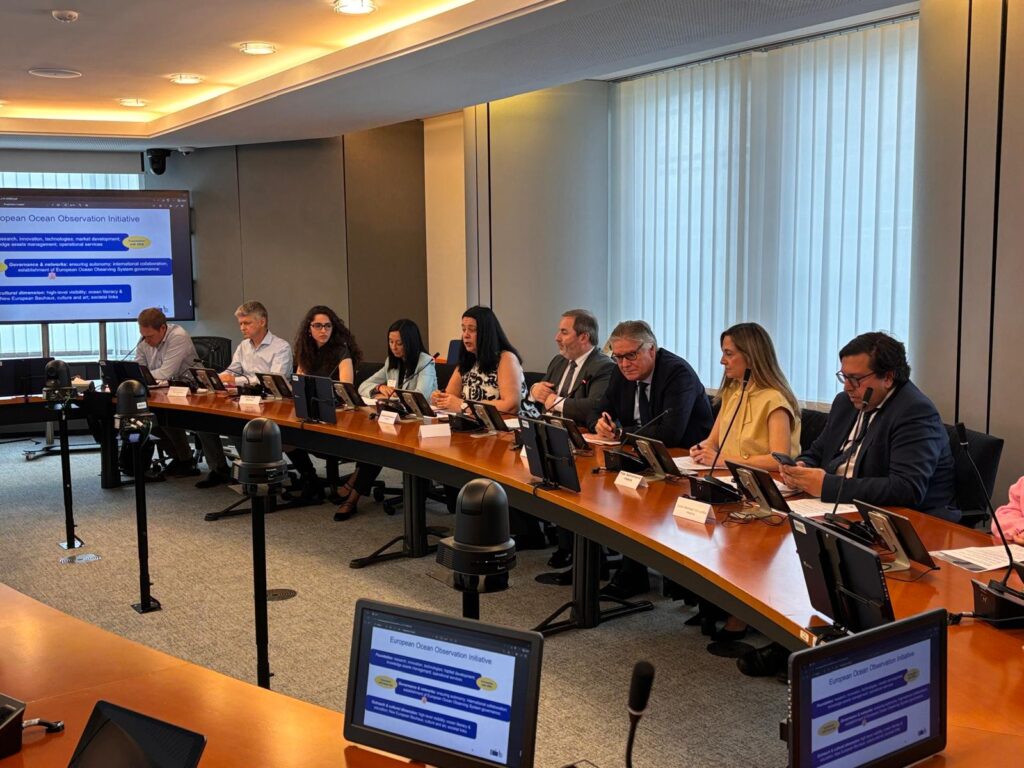
Opening the session, López-Istúriz underlined that protecting the environment must go hand in hand with preserving Europe’s competitiveness”. “Effective environmental policies should be science-based, proportionate and support innovation, ensuring both sustainability and economic growth”.
This was also highlighted by MEP Paulo do Nascimento Cabral, First Vice-Chair of the Fisheries Committee and member of the Ocean Pact Task Force of the EPP Group, who also call for policies based in scientific data stressing the need to take into account all stakeholders connected to the seas reminding that “some coastal communities like the outermost region of the Azores, my home town, are exclusively depending on the sea and they are interested in protecting the ocean”. “We must think about a triple sustainability: economic, environmental and social”. He also asked to move beyond national borders to ensure effective marine governance. On the Ocean Pact he insisted that fisheries and the fishers cannot be left outside “and this is what we defended from day one”.
Andreea Strachinescu, Head of Unit for Maritime Innovation, Marine Knowledge and Investment at DG MARE, European Commission, highlighted “the importance of marine data, observation systems and digital tools to make invisible pollution visible”. Her intervention connected emerging contaminants such as microplastics, PFAS and pharmaceutical residues with broader EU efforts around the European Digital Twin Ocean, harmonised data and the future European Ocean Observation Initiative.
From the scientific side, Marinella Farré, Coordinator of the ONE-BLUE project and researcher at IDAEA-CSIC, presented the project’s role in strengthening the evidence base on emerging contaminants. She warned about “the impacts of climate change on marine ecosystems and underlined the need to continue monitoring, develop new technologies and improve the exchange of data between scientists, citizens, stakeholders and policymakers.”
The event also included a roundtable on stakeholder engagement and clustering for greater policy impact, moderated by Irene Solé, ONE-BLUE Communications, with the participation of Marinella Farré, Bavo de Witte from CONTRAST/ILVO and Piet Seuntjens from VITO.
During the discussion, speakers highlighted the importance of stronger science-policy cooperation, participatory monitoring, prevention, safer chemical alternatives and better communication between research projects and European institutions. They also pointed to the need for more integrated data and sampling across Europe to better understand the presence and impact of new pollutants.
The event concluded with final remarks by Juan Manuel Revuelta, CEO of Finnova, who addressed funding opportunities and the importance of continued European cooperation.
Through the session, presented by the director of Communication of Finnova, Pilar Santamaría, ONE-BLUE reinforced the need for a coordinated, evidence-based and participatory approach to protect European seas from invisible but increasingly urgent forms of pollution, at a particularly timely moment marked by the launch of the European Commission’s Ocean Observation Initiative.
About One Blue
ONE-BLUE is a Horizon Europe project coordinated by IDAEA-CSIC that investigates contaminants of emerging concern in marine and aquatic ecosystems and their impacts on biodiversity and human health. With a budget of €6.2 million, the project brings together more than 100 researchers from 18 institutions across 11 European countries. By generating robust scientific evidence, ONE-BLUE contributes to strengthening environmental policymaking and supporting the protection of Europe’s seas and waters.