- The studies highlight the impacts of plastic pollution and the effectiveness of protected areas in marine conservation in the Mediterranean
- The conference brought together ornithologists and nature enthusiasts in Lecce, marking the first edition in Apulia in more than 40 years
Federico Tossani, researcher at the Dipartimento di Scienze e Politiche Ambientali of the Università degli Studi di Milano (UNIMI), represented the European project ONE-BLUE at the 22nd Italian Ornithology Conference, held from 8 to 12 September 2025 in Lecce, Italy. During the event, Tossani presented two studies focused on Scopoli’s shearwater (Calonectris diomedea), an endemic Mediterranean species and a potential bioindicator of marine ecosystem health.
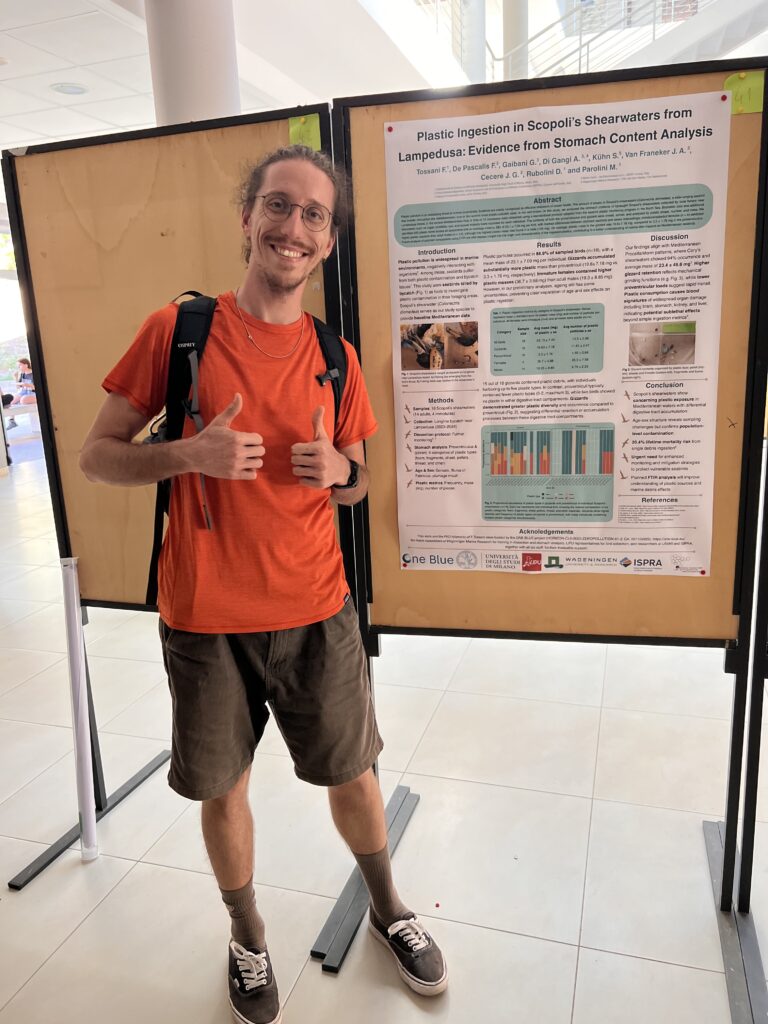
The first study, “Plastic Ingestion in Scopoli’s Shearwaters from Lampedusa: Evidence from Stomach Content Analysis”, examined the stomach contents of 18 specimens collected as fisheries bycatch near the island of Lampedusa. Results showed that 88.9% of the birds had ingested plastic, with an average mass of 23.1 ± 7.09 mg per individual. The gizzard accumulated significantly more plastic than the proventriculus (19.8 ± 7.18 mg vs. 3.3 ± 1.76 mg), reflecting their different digestive functions. Immature females showed higher plastic burdens than adult males, although these differences should be interpreted with caution due to uncertainties in age determination. In total, six categories of plastic were identified, with some individuals containing up to five different types. These preliminary results contribute to a better understanding of plastic exposure in Mediterranean seabirds and will support ongoing monitoring and future mitigation strategies.
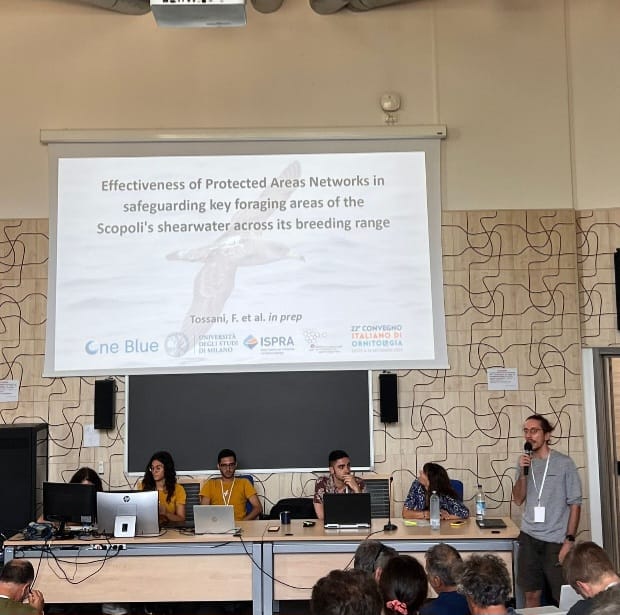
The second study, “Effectiveness of Protected Areas Networks in safeguarding colonies and key foraging areas of the Scopoli’s shearwater across its breeding range”, assessed the effectiveness of protected areas (PAs) in safeguarding both breeding colonies and key foraging zones of the species throughout the Mediterranean. Based on expert questionnaires on land-based threats and GP tracking data from 815 individuals across 16 colonies over 17 years (2007–2024), Important Conservation Areas (ICAs) were identified. When overlaid with the existing PA network and spatial data on human pressures (fishing effort, tanker traffic, and offshore infrastructure), the preliminary results revealed protection gaps and highlighted the need for more coordinated international management.
Both studies are part of ONE-BLUE’s Mediterranean case study, which aims to assess the impact of emerging contaminants such as micro- and nanoplastics on marine biodiversity and to provide scientific reference data to support conservation policies and European frameworks such as the EU Biodiversity Strategy for 2030 and the Zero Pollution Action Plan.

The 22nd Italian Ornithology Conference, organized by CISO (Centro Italiano Studi Ornitologici), the University of Salento, the Institute of Research on Terrestrial Ecosystems of the National Research Council (CNR-IRET), LifeWatch Italy and Or.Me., brought together ornithologists and nature enthusiasts in Lecce. This edition, the first in the Apulia region in over 40 years, featured scientific sessions, posters, symposia, round tables and field excursions, fostering knowledge exchange, networking, and the promotion of the region’s natural heritage.