- This is the first of nine campaigns that will be carried out during the duration of the project.
- This sampling campaign has been led by our partner the Alfred Wegener Institute.
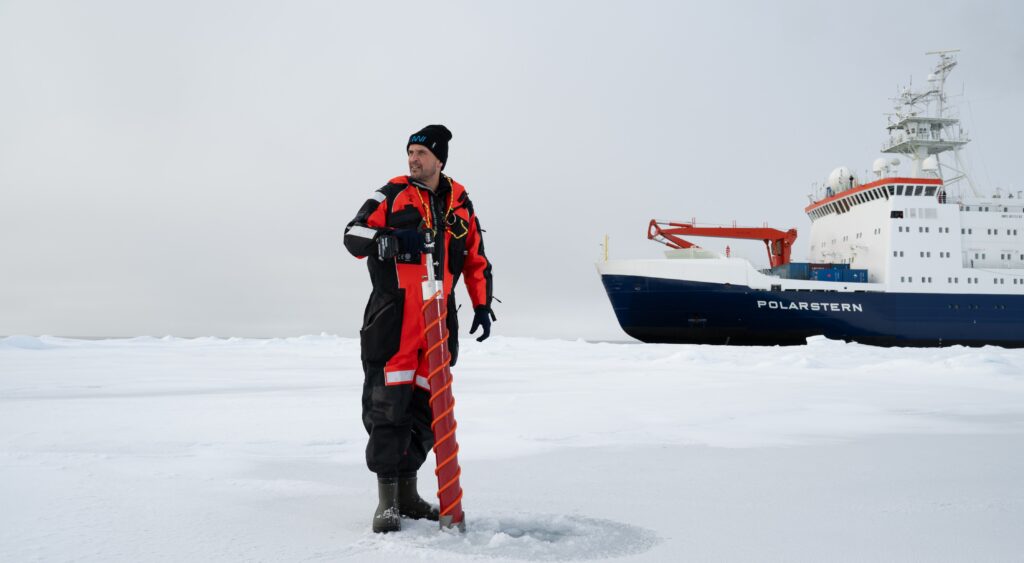
ONE-BLUE has started its first sampling campaigns in the Arctic Ocean. Precisely, the Arctic Ocean is one of the three case studies (together with the Atlantic Ocean and the Mediterranean Sea) on which the research of our project will focus, investigating the effect of pollutants of emerging concern on the marine biodiversity of these areas.
This research has been carried out in the Central Arctic, in a total of 79 sampling stations. Within these stations, the team has collected a total of 484 samples, most of them (more than 380) corresponding to samples collected from the ocean. In addition, snow, sea ice and ice water samples were also collected.
This expedition was led by our partner the Alfred Wegener Institute, led by Boris Koch, Deputy head of Division Biosciences and Deputy head of Section Ecological Chemistry in AWI and had Xianyu Kong on board, researcher of the Department of Ecological Chemistry and member of ONE-BLUE. The team consisted of a total of 6 people from AWI and Helmholtz Centre for Environmental Research who contributed to the extraction of the samples.
Investigation in the Arctic Ocean is key as the zone of our planet has a key role in the climate systems of the Earth. Also, it is one of the most affected areas of the globe when it comes to climate change, as it has been losing more of its 10% ice extent per decade. Moreover, density data in this zone is really low, given the transportation problem to reach these far places. For all those reasons, the Arctic Ocean is one of the case studies of ONE-BLUE project.