- This activity is included in ONE-BLUE work package 3, forming part of the conclusions that will be drawn on the Mediterranean Sea case study
- The ECVP Congress brought together specialists, residents, and trainers in veterinary pathological anatomy in Turin
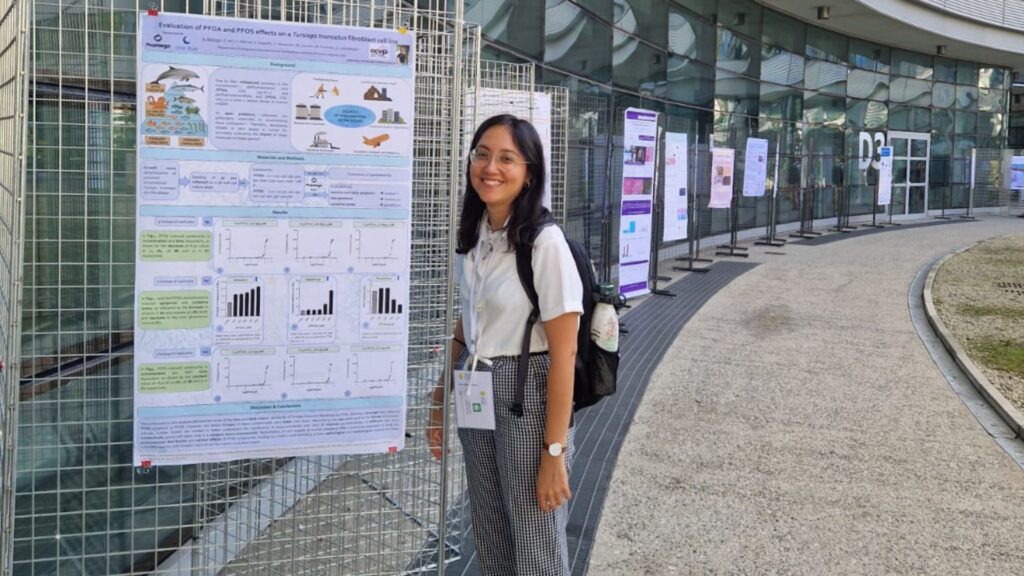
The University of Padova (UNIPD) represented the ONE-BLUE project from August 27 to 30 at the European Society of Veterinary Pathology – European College of Veterinary Pathologists (ESVP-ECVP) Congress held in Turin (Italy). Antonella Molinari, PhD student at UNIPD, presented a poster entitled “Evaluation of PFOA and PFOS effects on a Tursiops truncatus fibroblast cell line.”
This poster analyses the effects of perfluorooctanoic acid and perfluorooctane sulfate on fibroblast cells obtained from bottlenose dolphins. In collaboration with the Mediterranean Marine Mammal Tissue Specimen Bank of UNIPD, the study of analysis of stranded mammal specimens such as Tursiops will be carried out over an extended period, assessing the time trend of bioaccumulating compounds, to highlight the effectiveness of mitigation measures and restrictions and the replacement of synthetic chemicals.
PFOA (perfluorooctanoic acid) and PFOS (perfluorooctane sulfonate) are two of the best-known environmental pollutants within the large family of PFAS (perfluoroalkyl and polyfluoroalkyl substances). PFAS are contaminants of emerging concern and are currently under scrutiny for future regulation due to their potential adverse effects on the environment and human health. ONE-BLUE will enhance the knowledge of the impact of PFAS on marine environments by utilising the data collected in the Mediterranean case study.
The ESVP/ECVP Congress 2025 has focused on empowering the role of the pathologist in the next-generation era, exploring several key topics in veterinary pathology. This congress will serve as a platform for both established experts and early-career veterinary pathologists to explore how recent developments in digital pathology, artificial intelligence, molecular techniques, and ‘omics’ approaches are revolutionising veterinary diagnostics and research.