- ONE-BLUE completed its 4th sampling campaign out of the 9 that will carry out during the project.
- HCMR hosted in this expedition researchers from ONE-BLUE partners IDAEA-CSIC and ICM-CSIC
On January 8–9, 2025, the ONE-BLUE project conducted its fourth marine sampling campaign in the Aegean Sea, with a focus on the Saronikos Gulf (Greece). Led by the Hellenic Centre for Marine Research (HCMR) and Dr. Efi Cotou as expedition leader, the mission brought together a multidisciplinary team of dedicated scientists and technical staff aboard HCMR’s 62-meter oceanographic research vessel, R/V AEGAEO. The team included a vessel crew of twenty people, nine permanent researchers and three technicians from HCMR’s Institutes of Marine Biology, Biotechnology and Aquaculture (IMBBC) and Institute of Oceanography (IO). They were joined by two hosted PhD students and one technician from the Spanish partner institutions IDAEA-CSIC and ICM-CSIC, respectively.
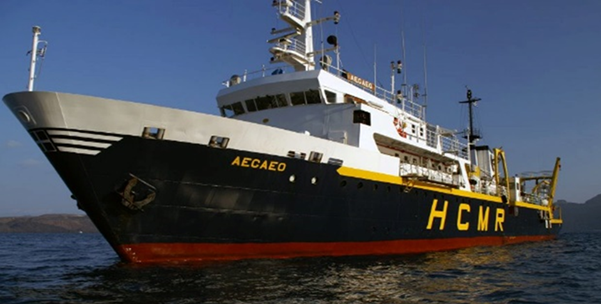
Over two days, the team collected seawater and sediment samples from 11 strategically selected stations in the Saronikos Gulf. Sampling sites were located near fish and shellfish farms, industrial and shipyard zones, domestic and industrial wastewater treatment plants, and a river estuary, to capture a representative range of anthropogenic influences.
Seawater was sampled at multiple depths, ranging from the surface to 400 meters, including surface, mid-column, and near-bottom layers. Sampling was performed using a Rosette sampler equipped with twelve 12-litre Niskin bottles and CTD sensors, measuring temperature, salinity, dissolved oxygen, chlorophyll and depth. Sediment samples were obtained using a box corer. Additionally, surface-floating microplastics were collected using a manta net (200 μm mesh).
232 samples were collected to assess the presence, concentration and potential effects of chemical contaminants of emerging concern (CECs). These samples will support ongoing evaluations of their impacts on marine organisms and ecosystems through chemical analyses, in vitro and in vivo bioassays, toxicity tests, and assessments of bacterial biodiversity.
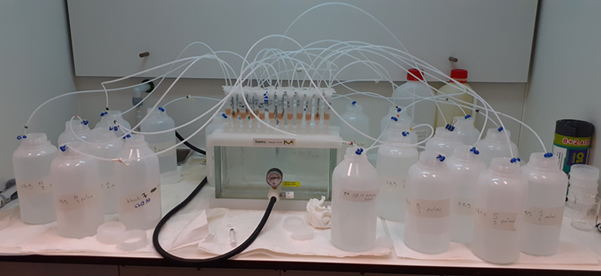
For chemical analysis, seawater samples were spiked on board with internal standards and stored at low temperatures throughout the campaign. Samples intended for bioassays and toxicity tests were not spiked and were also kept chilled. Solid phase extraction (SPE) was later carried out in HCMR laboratories by the HCMR team.
For bacterial biodiversity, the Spanish team filtered seawater samples on board and stored frozen until they were transported to the HCMR laboratories, where they were preserved at -80 °C. On the other hand, sediment samples from the top 2-3 cm layer were placed in aluminium trays and Falcon tubes, stored at -20 °C on board, and subsequently transferred and maintained at -20 °C in HCMR laboratories.
The results provided by these samples will contribute to the overall results for the Mediterranean Sea, one of the three ONE-BLUE case studies. The Mediterranean Sea has been selected as a case study due to its nature as a semi-enclosed basin that receives a significant influx of pollutants from surrounding coastal areas. It is currently considered to be in a critical ecological state because of overexploitation, intense anthropogenic pressures, and the ongoing impacts of climate change.