Researchers from ONE-BLUE presented new findings on emerging contaminants, marine pollution and ecosystem impacts at one of Europe’s leading environmental science conferences.
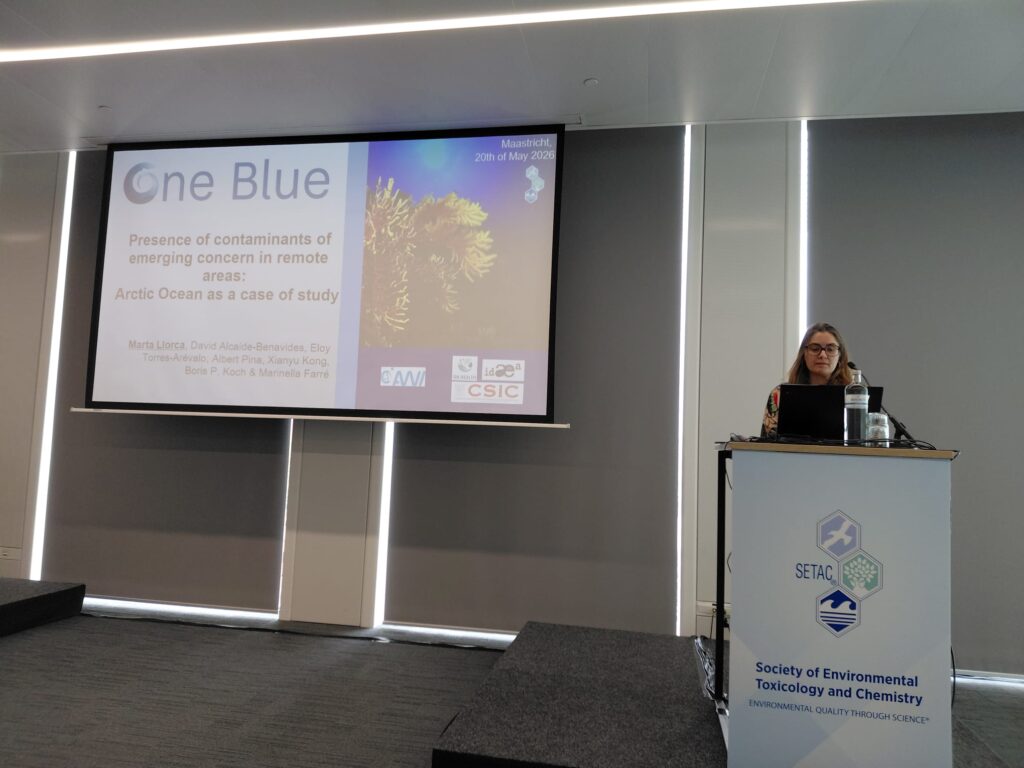
ONE-BLUE partners took part in SETAC Europe 2026, held in Maastricht, the Netherlands, joining one of the leading European scientific conferences in environmental toxicology and chemistry.
The event brought together researchers, institutions and stakeholders working on chemical pollution, ecotoxicology, environmental risk assessment and sustainability, providing a key forum to exchange knowledge on the environmental challenges affecting aquatic and marine systems.
From IDAEA-CSIC, Prof. Marinella Farré co-chaired the session “Navigating Marine Pollution in a Changing Climate: Emerging Contaminants, Ecosystem Impacts, and Integrated Solutions”, together with Prof. Steven Brooks, coordinator of the sister project CONTRAST, among other scientists.
The session explored how climate change is reshaping the way pollutants behave in marine environments, and how integrated scientific approaches can help assess their effects and support more resilient ecosystems.
Within this framework, the co-coordinator of the project Dr. Marta Llorca and the PhD researcher Edoardo Barbieri, both from IDAEA-CSIC, presented two oral communications linked to ONE-BLUE. Dr. Llorca presented “Presence of contaminants of emerging concern in remote areas: Arctic Ocean as a case study”, focusing on the detection of these substances in remote marine environments. Edoardo Barbieri presented “Integrative Growth Inhibition and Metabolomic Alterations on Marine Microalgae Tetraselmis suecica Exposed to CECs”, addressing their biological effects on marine microalgae.
ONE-BLUE was also represented through several scientific posters. Dr. Camilla Mariani, from the State University of Milan, and Dr. Sara Valsecchi, from the Italian National Research Council (CNR), contributed to the poster “Monitoring of Contaminants of Environmental Concerns along the coastlines of the Mediterranean Sea: the ONE-BLUE project”, presenting work on contaminant monitoring across Mediterranean coastal environments.
In addition, Valentina Araya Piqué, PhD researcher at IDAEA-CSIC, whose doctoral research is also linked to ONE-BLUE, contributed with studies on chemical contamination in marine organisms. She presented the poster “Mediterranean Seafood Under Scrutiny: Chemical Burden and Regulatory Implications” and the oral presentation “Multi-class Organic Contaminants in Brain and Muscle of Mallorcan Fish”.
Together, these contributions show the breadth of the project’s scientific work, from Arctic sampling and Mediterranean monitoring to laboratory studies on biological effects and research on seafood contamination.
ONE-BLUE’s participation in SETAC Europe 2026 reinforces its commitment to producing robust, policy-relevant evidence to better understand invisible pollutants and support science-based responses for healthier European seas.