The ONE-BLUE project has successfully concluded its sampling campaign along the Spanish Mediterranean coast, a key scientific effort aimed at advancing knowledge of CECs in the marine environment. The campaign was carried out over eleven consecutive days, from 25 July to 4 August, on board the Oceanographic Research Vessel Sarmiento de Gamboa.
The expedition brought together a multidisciplinary team of 30 professionals, including 15 researchers from the Spanish National Research Council (CSIC), from the Institute of Environmental Assessment and Water Research (IDAEA) and the Institute of Marine Sciences (ICM).
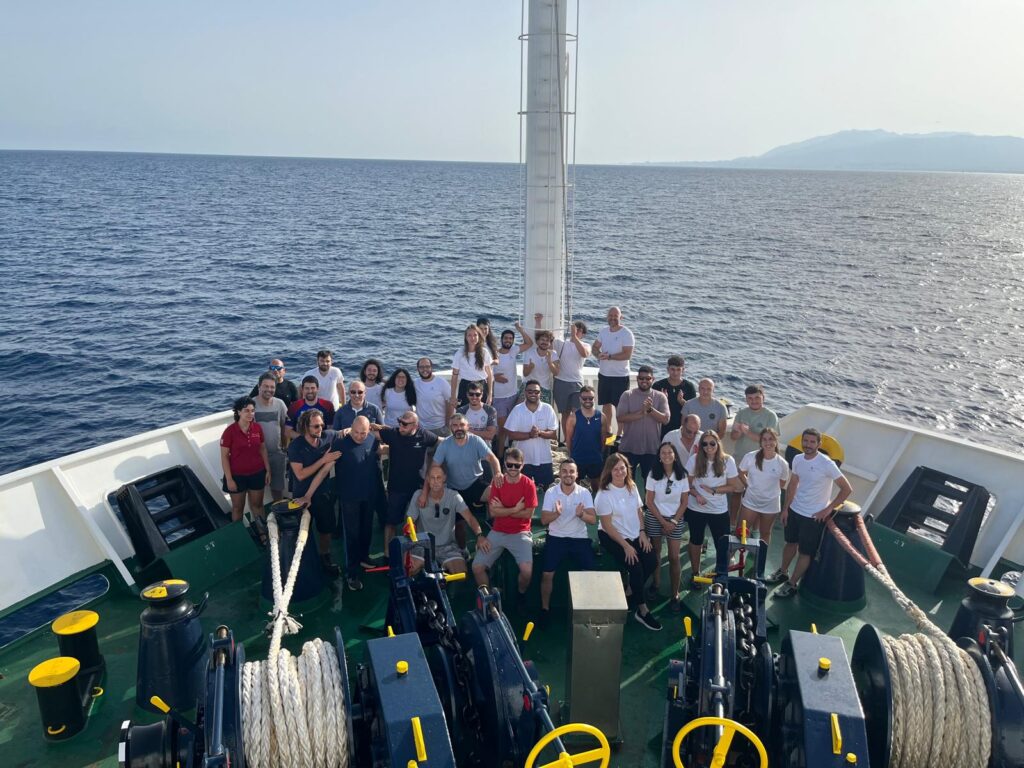
Participants in the Spanish Mediterranean coast sampling campaign aboard the R/V Sarmiento de Gamboa
The Sarmiento de Gamboa, in operation since 2007, is a 70.5m research vessel with a beam of 15.5m. It is equipped to accommodate up to 25 scientists and technicians, and has six specialised laboratories to support advanced marine research activities.
During the campaign, 26 strategically selected sampling stations were sampled along the Spanish Mediterranean coast, from Barcelona to Málaga, covering both coastal and open-sea areas. Water samples were collected using a CTD rosette. In deep-water stations, samples were taken at depths of 5m, 100m, 1000m, and from the seafloor. In coastal stations, sampling was conducted at 5m, 50m, and 100m. In some deep-water stations, samples were successfully collected from up to four distinct depths, allowing for a more detailed vertical characterisation of the water column.
In total, approximately 1.200 extractions were performed.
Sediment samples were obtained at all sampling points using a KC Denmark multicorer, reaching depths of up to 2.600 metres. Microplastic and nanoplastic particles were collected with a Manta Trawl, while atmospheric sampling was conducted using high-volume air samplers (HVS) placed on deck to capture airborne particulate contaminants and microorganisms.
This campaign represents a significant milestone for the ONE-BLUE project. The data and samples collected will provide essential information for the assessment of CECs in the marine environment and contribute to the development of effective strategies for monitoring and managing these pollutants.