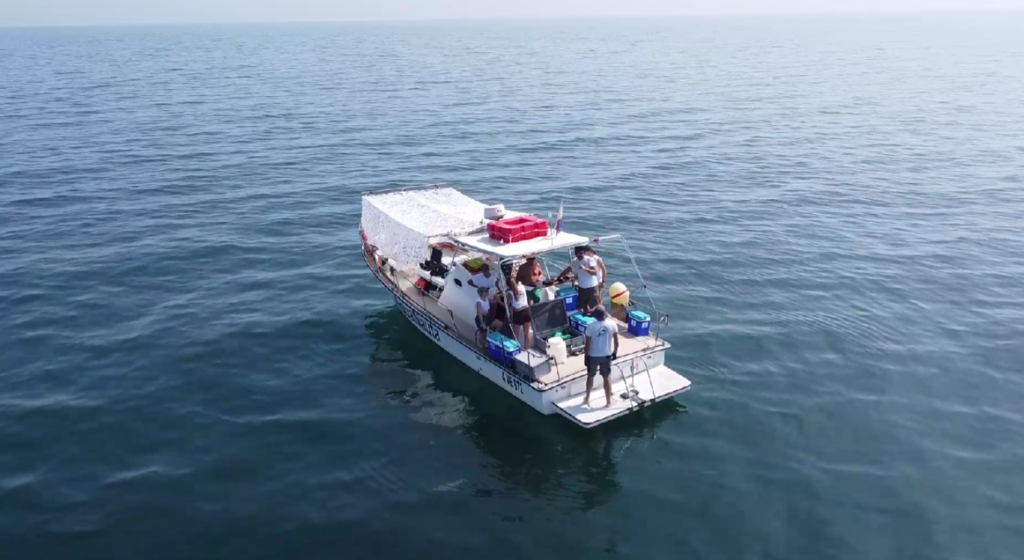
- The campaign, led by the University of Padova, will collect more samples between last week of September and first of October
- The CNR-IRSA is in charge of treatment of the samples collected in this campaign
The third ONE-BLUE sampling campaign started in the northern Adriatic in the first week of September, collecting samples at 2 of the 6 stations from the sampling plan. This expedition was led by Cinzia Centelleghe, researcher at the University of Padova (UNIPD), in collaboration with the Water Research Institute, an institute of the Italian National Research Council (CNR-IRSA).
The first two stations were located 3 and 8 nautical miles from the coast each, off the Caorle-Jesolo tourist area. In this expedition, 30 liters of water were collected from each station using Niskin water bottles at different depths. At the coastal station, samples were taken at 1 meter depth and on the seabed (15-meter depth, maximum sea depth), while at the open sea station water samples were taken at three depths: 1 meter, 10 meter and on the seabed (18 meter). Sediments were sampled with an Ekman dredger at both stations.
For this first campaign, it was not possible to use the vessel “Goletta Verde”, but a suitable alternative vessel was used. Water and sediment samples were transported to the University of Padova and prepared according to the ONE-BLUE protocol under the supervision of Sara Valsecchi, scientific researcher at CNR-IRSA.
Some of the water samples were filtered for analysis of microplastics and environmental biodiversity, while the rest were extracted using Solid Phase Extraction (SPE) cartridges and they will be sent to chemical and ecotoxicological laboratories. The sediment was separated into aliquots for chemical and ecotoxicological analysis.
Future steps in North Adriatic Sea
After this first expedition, the second and third sampling events in the North Adriatic are planned for the last week of September and the first week of October. The campaigns will be focused on collecting fish and shellfish samples, as biota will be dissected for subsequent chemical analyses.
In the northern Adriatic the stations will cover a total of 80 km of coastline, collecting samples from coastal stations (up to 3 nautical miles from the coast) and from the open sea (about 8-12 nautical miles). The main rivers of the Padana plain flow through this area, the most industrialized in Italy, feeding one of the most important fishing and fish farming areas in the Mediterranean. The stations include both protected areas according to the Habitats Directive and the Natura 2000 network North Adriatic – Po Delta (SIC IT3270025), as well as fishing areas off the Venetian lagoon.