- The event, hosted by Finnova Foundation, brought together representatives from the European Commission, research organisations and creative initiatives to explore how science, education and art can strengthen ocean literacy and public engagement.
Brussels, 5 November 2026. On 29 October, the European project ONE-BLUE organised “ONE-BLUE: Engaging Young Europeans through Ocean Literacy” at Finnova Foundation in Brussels, as part of the European Maritime Day (EMD) in My Country 2026 initiative. The hybrid event brought together European institutions, researchers and organisations working at the intersection of marine science, environmental education and participatory art to discuss new approaches to engaging young Europeans and local communities in ocean protection.
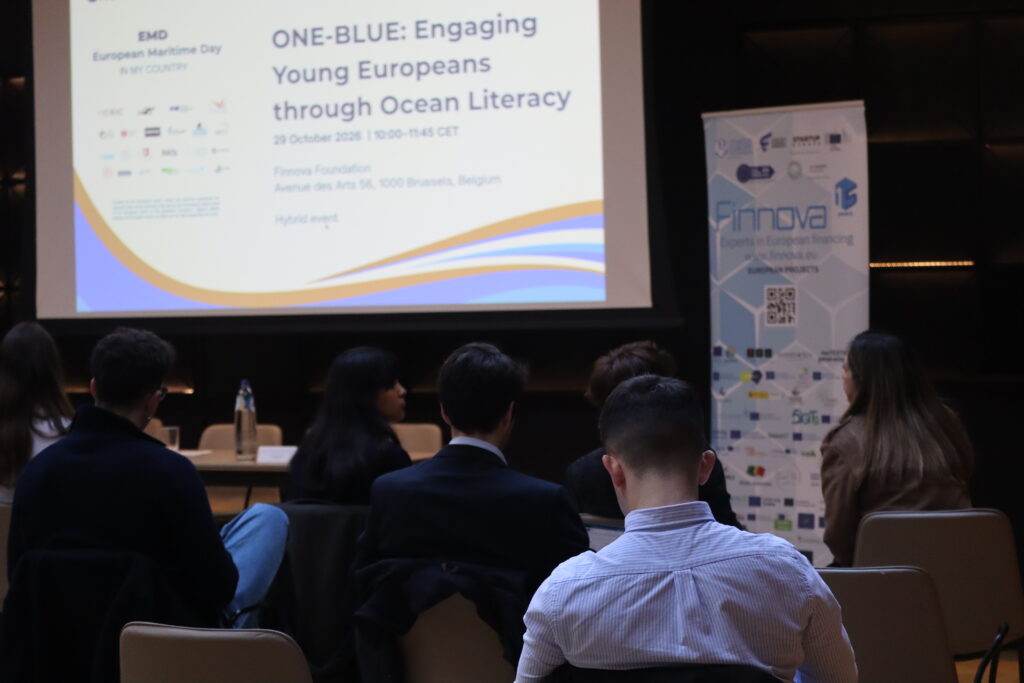
The event opened with welcoming remarks from Pilar Santamaría, representing Finnova Foundation, followed by a presentation from ONE-BLUE coordinators Marinella Farré and Marta Llorca, from the Institute of Environmental Assessment and Water Research (IDAEA-CSIC). Under the title “ONE-BLUE: From Marine Research to Scientific Communication”, they introduced the project’s research on emerging marine contaminants and highlighted the importance of communicating scientific findings beyond the research community. Their intervention provided the context for the discussions that followed, connecting ONE-BLUE’s scientific objectives with the role of ocean literacy in raising public awareness and encouraging engagement with marine environmental challenges.
Strengthening ocean literacy across Europe
The first session focused on European initiatives to promote ocean literacy and strengthen the relationship between science and society.
Evelyn Paredes Coral, from the European Commission’s Directorate-General for Maritime Affairs and Fisheries (DG MARE), presented the EU4Ocean Coalition, highlighting its work to connect organisations, educational institutions and young Europeans through initiatives such as Partners4Ocean, Youth4Ocean and the Network of European Blue Schools. She introduced the opportunities these networks offer for education, mentoring, collaboration and youth participation in marine conservation and the sustainable blue economy.
Dina Eparkhina, from EuroGOOS, explored how ocean observations and scientific research can become more accessible and meaningful to society. She emphasised that scientific knowledge alone does not necessarily lead to public engagement or behavioural change, highlighting the need for approaches based on dialogue, trust and knowledge co-creation. Through practical examples related to marine pollution, she illustrated how citizen science, educational activities and creative communication can strengthen the connection between researchers and communities.
Connecting art, science and coastal communities
The second session explored the role of creativity and participatory approaches in advancing ocean literacy and addressing environmental challenges.
Raquel Ledo Doval, representing S+T+ARTS AQUA MOTION, presented an initiative that integrates artistic research into water governance through 25 artistic residencies across Portugal, the Netherlands, Austria and Italy. She explained how the project’s Water Innovation Labs bring together artists, scientists and local stakeholders to address water-related challenges, highlighting the value of interdisciplinary collaboration and community participation in developing innovative approaches to environmental issues.
Chiara Certomà and Caterina Pozzobon, from Sapienza University of Rome, introduced the European project PartArt4OW, which promotes participatory art as a tool for connecting communities with ocean and water-related challenges. Their presentation placed particular emphasis on the project’s second open call, focused on engaging Mediterranean communities in preventing, studying and tackling water pollution. The initiative demonstrates how artistic practices can complement scientific research and encourage citizens to participate actively in addressing marine pollution.
The session concluded with Irene Solé Quevedo, Director of Xarxa Oberta at Oceanographies Collective, who presented a community-based initiative developed in Barcelona’s coastal neighbourhood of La Barceloneta within the framework of PartArt4OW. Xarxa Oberta brings together artisanal fishers, scientists, artists and local residents through participatory activities that connect traditional fishing knowledge, cultural heritage and scientific research. The project explores the relationship between coastal communities and the sea, highlighting the importance of local participation in building sustainable blue economies and protecting marine ecosystems.
From dialogue to action: the future of ocean protection
The event concluded with an open exchange between the audience and speakers, providing an opportunity to reflect on the role of young Europeans, researchers and local communities in shaping the future of ocean protection.
Nekane Martín, from Finnova Foundation, presented European funding opportunities for initiatives related to the blue economy and ocean protection, highlighting the importance of EU support in turning innovative ideas into concrete projects.
The event closed with remarks from Pilar Santamaría, from Finnova Foundation, who moderated the discussion. Through its participation in European Maritime Day in My Country 2026, ONE-BLUE reinforced the importance of connecting scientific research with education, creativity and community engagement. The discussions highlighted that advancing ocean literacy requires not only making marine science more accessible, but also creating opportunities for citizens to participate actively in understanding and addressing the challenges facing our oceans.